



The Science Behind Neurofeedback: How Brain Insights Can Boost Learning Performance

NEMA AI
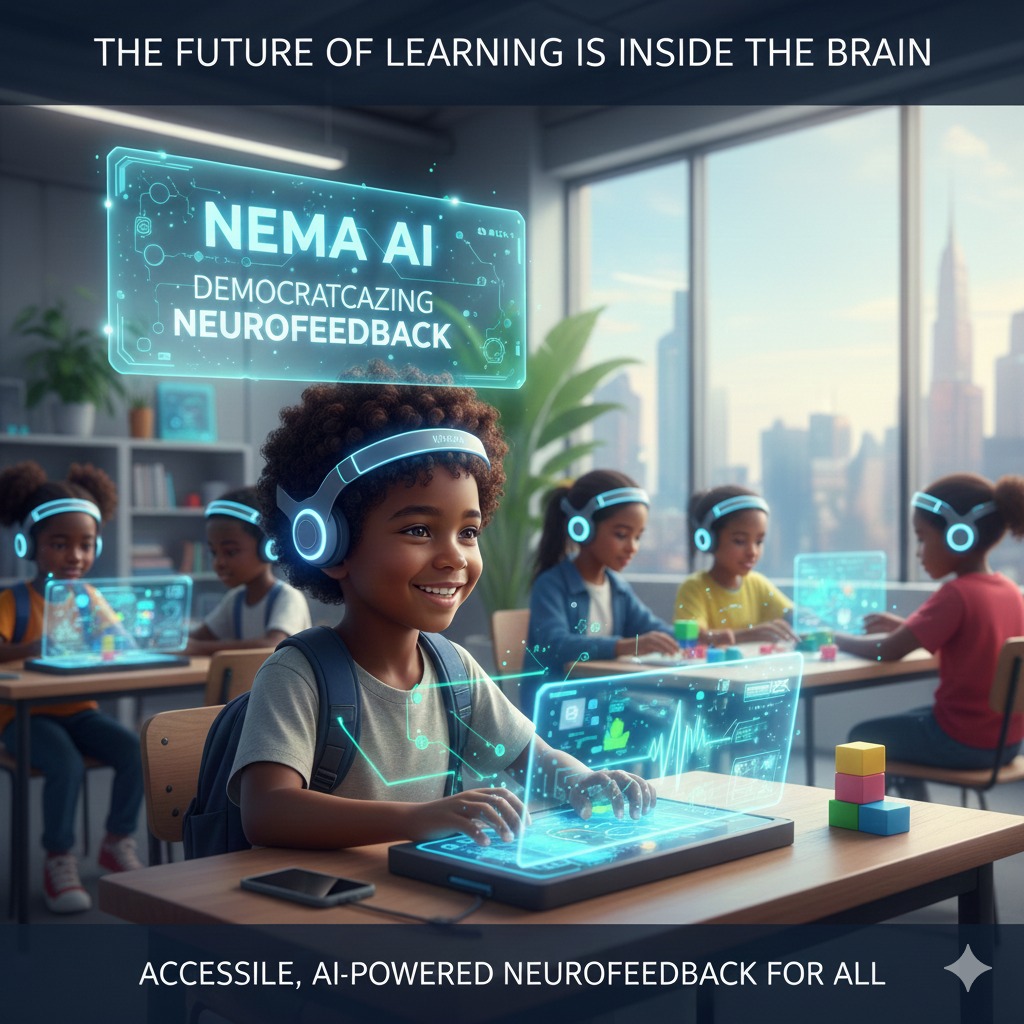
For a very long time, education has been about syllabus, textbooks, exams and outdated teachers' teaching methods. But the fundamental question remains: How does a child's brain actually respond while learning?
With the rise of neurofeedback and EEG-based brain monitoring, teachers and parents are gaining access to what was once invisible: the child's real-time brain activity. These insights are transforming our understanding of a child's memory, focus, learning challenges, and emotional regulation.
This shift is the beginning of brain-based personalised education.
What Is Neurofeedback?
Neurofeedback is a technique of brain training that helps individuals to observe and regulate their own brain activity in real-time. It is based on a simple and powerful idea:
When the brain can see how it is performing, it can learn to self-correct.
Using an EEG (electroencephalogram) by placing sensors on the scalp, neurofeedback systems measure our electrical brain signals. These signals are then translated into love visual or auditory feedback through games or animations.
For example:
- If a child's brain is focused and active, the game moves forward.
- If the same focus drops, the game slows down or pauses.
Over time, the brain learns the patterns through which the child stays focused, stays calm and processes information better.
How Neurofeedback Uses Real-Time Brain Data To Improve Learning
The Traditional Method relies on:
- Test scores
- Teachers observation
- Classroom behaviour
Whereas, Neurofeedback gives live brain data while the child is thinking, focusing or solving a problem.
- Focus and Attention: Children often struggle with long-term attention. Neurofeedback helps the child's brain recognise when the attention is drifting, and with time, it helps to train itself back into a focused state.
- Memory and Information Training: Certain brainwave patterns that support memory formation and recall. When neurofeedback encourages these healthy patterns, the child becomes better at retaining information and applying what they learn.
- Self-Regulation and Emotional Control: Learning is deeply connected to emotions like frustration, anxiety, burnout or restlessness that disrupt brain activity. With the help of neurofeedback helps children regulate their emotional responses that interfere with their learning performances.
- Overall Learning Efficiency: Instead of forcing children to adapt to traditional teaching methods, Neurofeedback helps to adapt to the natural rhythm of each child's brain.
This is for:
- School-going kids
- Children with learning difficulties
- Young learners who are still developing their attention control
The Science Behind Brain Waves and Learning
Our brain communicates through electrical signals called Brainwaves, which are measured in frequencies. Each frequency plays a role in how we learn, feel and respond.
Here's a simple overview:
- Delta (Deep Sleep): Physical restoration and healing
- Theta (Creativity & Daydreaming): Memory formation, imagination
- Alpha (Calm Focus): Relaxed alertness, ideal for learning
- Beta (Active Thinking): Problem-solving, attention, reasoning
- Gamma (Peak Performance): High-level cognition and memory processing
Learning for an individual works best when the brain can make a shift from Alpha, Beta and Gamma states. Students with attention challenges get stuck in patterns that make learning harder when overstimulated or mentally stressed.
Neurofeedback helps bring those brainwave patterns back into balance, allowing the brain to operate in its most efficient learning state.
What Research Shows About Neurofeedback in Education
Several neuroscience and psychology studies have shown that neurofeedback training can improve these factors in an individual:
- Executive functions like planning, decision-making
- Attention span and long-term focus
- Better emotional regulation
This makes neurofeedback beneficial for students with:
- ADHD
- Anxiety
- Learning disabilities
- Exam stress and performance pressure
Real-world Impact
Modern brain imaging has helped scientists to see what happens inside the brain during emotional and cognitive challenges. For example, research has shown that the ventrolateral prefrontal cortex becomes highly active when a teenage girl experiences social exclusion at her school. This is a response linked to the child's emotional pain and stress regulation.
The neuroscientist Steven Rose once critically asked:
“Brain imaging has apparently shown that the ventrolateral prefrontal cortex lights up when adolescent girls experience social exclusion, but does this guide as to how youngsters might be helped?”
This questions the limitations of traditional brain imaging techniques, i.e observation alone is not enough.
The neurofeedback technique is filling this gap by providing direct and real-time actionable training and insight.
Neurofeedback Meets AI: The Role of NEMA AI
One such platform, NEMA AI, is a bridge between neuroscience and artificial intelligence to make neurofeedback widely accessible, personalised and practical for education.
NEMA AI offers:
- EEG brain sensing
- Neurofeedback training
- AI-Powered learning analysis
How NEMA AI Tracks Brain Response During Learning
Here, NEMA AI uses short cognitive tasks and interactive games to understand how the child's brain reacts during learning activities.
How it works:
1. Wearing an EEG Headset: The child wears an EEG headset while engaging in small cognitive games.
2. Live Brain Data: The overall process measures attention levels, mental workload, emotional responses, interaction and engagement of an individual.
3. The AI Algorithm Analyses Cognitive Patterns:
- When the child has the best focus level.
- Any mental fatigue during a task or learning activities.
- What causes stress or increases confidence in students?
4. Personalised Learning Programs are created based on the reports of the brain response. Learning is optimised based on:
- Speed
- Cognitive patterns
- Any difficulty
- Emotional comfort
5. Parents And Teachers Get Brain-Based Insights: They get the objective data on how the child learns best.
Why Neurofeedback Is Especially Impactful for Children
A child's brain is highly neuroplastic, meaning it can change and adapt faster than an adult's brain. This makes Neurofeedback powerful.
- They can adapt very quickly.
- Stronger emotional self-regulation
- Improved attention span and classroom behaviour
- Better academic performance
Change Of Approach
Traditional education focuses on identical classrooms, the same old timetables and cliche teaching methods.
Today, Neurofeedback is helping this outdated model to shift towards:
- Student-friendly learning pace.
- Focus on the strength of the students and personalise accordingly.
- Emotion-aware education.
- Alignment of students' cognitive patterns.
Safe, Accessible and Affordable EEG Tool
Today, Portable and Affordable EEG Technology has made learning more engaging and interactive for students.
Platforms like NEMA AI have proven that:
- Brain monitoring can be safe and non-invasive
- Can be used in schools and learning centres
This accessibility is important for:
- Developing regions
- Resource-limited schools
- Children who don’t have access to expensive clinical therapy
By combining EEG with AI, neurofeedback is no longer a luxury of elite neuroscience; it is becoming a democratised learning support system.
Conclusion: The Future of Learning Is Inside the Brain
Neurofeedback is not just a technology- it is a standard shift in how we understand learning itself. Working directly with real-time brain data, education moves from surface-level judgment to deep cognitive understanding.