



Can a 5-minute EEG Replace MRI for Cognitive Testing

NEMA AI
MRI scan has been the most reliable option for diagnostic use. When it comes to understanding the brain, MRI has been considered the ideal tool for this purpose. The scans capture very detailed images of our brain’s structure from minor tissue changes, which makes it important for diagnosing conditions like dementia, tumors, strokes, or any traumatic injuries. But the landscape of brain diagnostics is shifting.
As healthcare moves toward faster, more accessible, and patient-friendly tools, a new question is emerging:
Can a simple, 5-minute EEG scan ever replace the need for an MRI?
- MRI provides detailed information about what the brain looks like- its shape, structure, and physical changes.
- EEG tells us what the brain is doing in real time.
- Use of EEG has increased; it captures functional detail of the brain, such as:
- Brainwave patterns that are connected to our focus and attention.
- Signals that are usually associated with memory and our cognitive processing.
- Early indication of cognitive decline in senior citizens.
- Patterns related to stress, sleep issues, or any neurological dysfunction.
Today's technological advancements introduce portable headsets that provide AI-powered analysis paired with digital platforms that provide quick scans by offering objective data (Information that is based on facts, not on opinions) in just minutes.
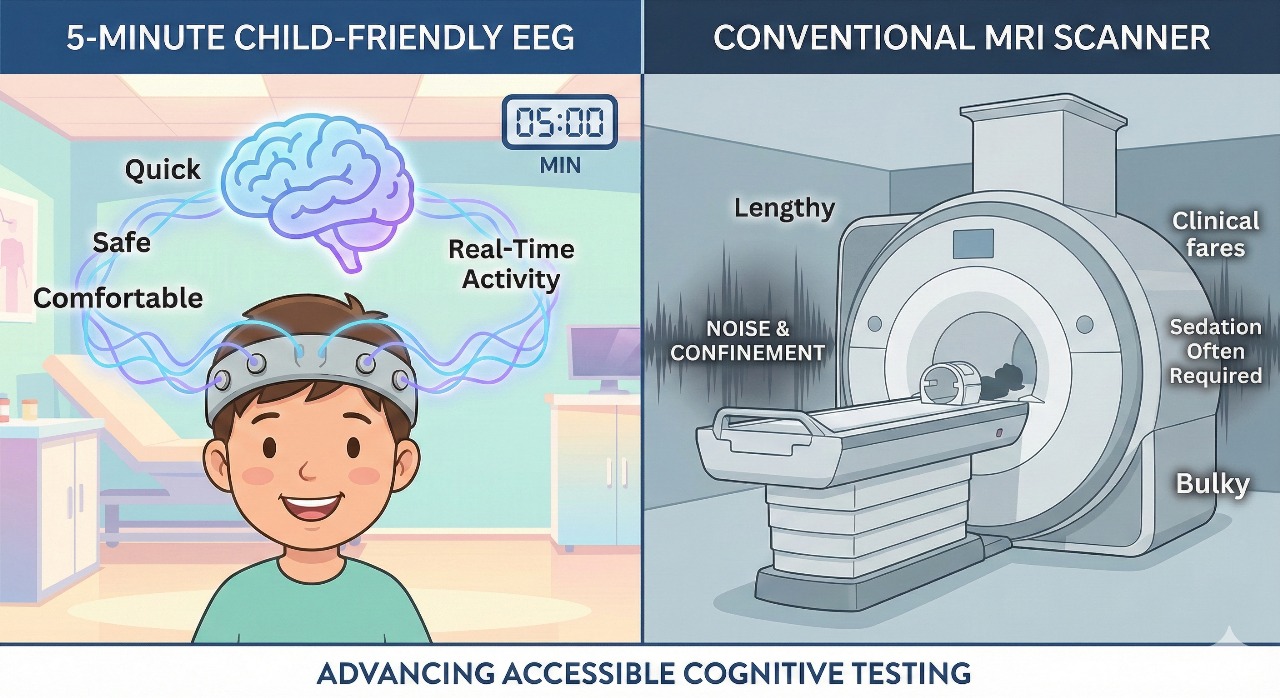
EEG, for its benefits, is fast, has no high radiation, and is pocket-friendly for the patient. This scan is becoming a valuable first-line assessment tool before considering MRI, specifically when an early screening or functional evaluation is needed.
EEG-Based Screenings vs. Traditional MRI Scans: What’s the Difference?
What both the scans measure:
EEG (Electroencephalography)
- EEG shows functional activities, such as brainwaves that are produced by our neurons.
- It also demonstrates how the brain functions in real-time.
- It is useful for assessing focus, memory, cognitive workload, attention deficits, sleep patterns, and early functional changes often missed by structural scans.
MRI (Magnetic Resonance Imaging)
- Gives us structural details, physical shape, and anatomy of the brain.
- Shows what the brain looks like.
- Great for identifying tumors, strokes, lesions, atrophy, hemorrhage, or any neurodegenerative structural changes.
Use Cases of EEG
EEG is best for:
- Early cognitive screening
- Tracking focus, memory, stress, and brain performance
- Detecting functional abnormalities before structural damage occurs
- Monitoring brain activity in real time
MRI is best for:
- Shows structural damage or disease
- Diagnose tumors, lesions, strokes, and atrophy.
- Follow up when EEG abnormalities suggest the presence of underlying issues.
AI-Powered Brain Scan:
As brain health has become a top priority these days, AI is transforming how we analyze and interpret our brain data.
Where AI Fits In
AI can:
- The introduction of AI has increased processing time for images and signals. By delivering results in minutes that used to take hours.
- AI has enhanced diagnostic accuracy by noticing micro-patterns that humans may overlook.
- Detection of early-stage changes related to cognition, memory, or any cognitive decline.
- Offers low costs by reducing dependency on large imaging machines.
- Gives standardised interpretation.
Introducing NEMA AI
One of the growing players in this space is NEMA AI, which is focusing on quick, non-invasive EEG recording and brain insights.
NEMA AI’s platform combines:
- 5-minute EEG screenings
- Automatic AI analysis of brainwave activity
- Digital dashboards that interpret complex signals into cognitive markers like attention, memory load, brain fatigue, and early functional decline
- Instead of waiting weeks for MRI reports, Clinicians and users get instant reports by making brain health monitoring easy and fast.
Benefits of AI-Powered Brain Scans
- Speed- analyse EEG or imaging data instantly, which enables same-session clinical decisions.
- Affordability- Lower equipment costs and reduced specialist dependency = accessible screenings for large populations.
- Accessibility & Portability- Portable EEG systems paired with cloud-based AI make brain health assessments possible in:
- Clinics
- Community centers
- Corporate health programs, Schools
- Rural or underserved areas
- Early Detection- By identifying functional changes before structural damage appears on an MRI, AI-based EEG tools are becoming early warning systems for cognitive decline.
Challenges That Still Need Attention
Despite the fast progress, AI-driven brain diagnostics face some problems:
- Bias- If existing data contains biases, AI can perpetuate misinformation and exacerbate health disparities.
- Data Privacy & Security - An AI system stores highly sensitive patient data, which can create problems if the data is compromised.
- Clinical Validation- AI models must be properly tested because they bear a significant responsibility for human-centric information.
- Regulatory Approval- Healthcare AI tools need government approval or formal clearance of institutions like the Indian Council of Medical Research (ICMR), and ethical guidelines and research through the National Institute for Research in Digital Health and Data Sciences (NIRDHDS)
- The Role of Human Experts- AI can augment, but expert interpretation remains important for complex cases.
Real-World Applications Already Emerging
AI-powered brain scan technologies are currently being tested or deployed in areas such as:
- It gives an overview of early cognitive decline screening (EEG-based and functional detection)
- For people who work in corporates, Workplace fatigue and focus assessments
- Regular digital mental health monitoring
- Children with special needs undergo an EEG, which gives a Neurodevelopmental screening.
- Continuous cognitive health tracking for adults and seniors
Platforms like NEMA AI are making it accessible by combining EEG and AI, which can become part of everyday neurological care.
A 5-Minute EEG Won’t Replace MRI, But It’s Changing the Future of Brain Screening.
A 5-minute EEG scan cannot replace the depth and structural clarity of an MRI. MRI is still essential for detecting tumors, strokes, lesions, bleeds, and the anatomical changes that characterize many neurological disorders. Its precision is unmatched, but so are its limitations: high cost, long wait times, limited accessibility, patient discomfort, and the need for heavy infrastructure.
This is where modern EEG + AI systems are rewriting this narrative.
Instead of replacing MRI, EEG is becoming a powerful first-line assessment tool, enabling a quick screen, showing changes early, and classifying who actually needs an MRI. It reduces unnecessary scans, makes brain health more accessible, and brings cognitive assessments into everyday settings such as clinics, workplaces, schools, and communities.
In today’s world, the smartest approach isn’t choosing between EEG and MRI-
It utilizes fast EEG-based screening as the front gate, and MRI as the deeper structural follow-up when needed.